
Urban Mysticism 101: Spiritual but not dogmatic
- 8 hours ago
- 5 min read

Spirituality sometimes has a PR problem. It sounds like incense and escapism. Like secret orders, complicated symbols, people who know too much about zodiac signs and too little about boundaries and structure.
And mysticism? Mysticism often sounds like something that only happens in monasteries. Or on mountaintops. Or somewhere with bad Wi-Fi. But here’s the truth: Mysticism isn’t exclusive. Mysticism isn’t elitist. Mysticism isn’t “for the initiated.” Mysticism is profoundly human. An open door within. A moment when life suddenly feels bigger than the to-do list.
What is mysticism, really?
At its core, mysticism is simple: mysticism is the direct experience of the divine, of wholeness, of the depth—beyond dogma, beyond words. Not knowledge about spirituality. But the experience of connection.
Mysticism doesn’t ask:
"What should I believe?" (and who tells me that?)
Mysticism asks:
„What can I experience?"
Directly—in relation to whatever you feel as divine, sacred, or greater than yourself. It’s about presence. About wonder. About that sense that something in us—and around us—is bigger than the ego. Mysticism isn’t religion. Mysticism is a dimension that appears in many religions, but belongs to none.
Mysticism as an attitude, not secret knowledge
Mysticism is not a VIP lounge. It’s not an exclusive club for the initiated, not a spiritual high-performance sport, and certainly not a certificate to hang on your wall someday. Mysticism isn’t about “I’m further along than you,” not the silent ranking that sometimes sneaks into spiritual and religious spaces.
Mysticism is more like the opposite: an attitude. An openness. A listening. It lives in moments that don’t need to be spectacular to be real. In a quiet instant amid chaos. In a breath that grounds you when everything feels too much. In a glance at the night sky between two tram stops, when the city pauses for a moment. Or in that feeling that life sometimes doesn’t just happen—it breathes through you.
Mysticism isn’t exclusive. Mysticism isn’t “us versus them.” It’s open. It doesn’t belong to the loud, the enlightened, or the “especially spiritual.” It belongs to being human.
What kinds of mysticism exist?
When people ask about types of mysticism, they often mean: Are there different traditions? Different ways humans encounter the divine? And yes—there are. Mysticism isn’t a single school or fixed system. It’s more a human impulse, appearing across cultures and religions wherever people didn’t just want to believe—but to experience. We see mystical currents in many major traditions:
In Christian mysticism, like Teresa of Ávila or Meister Eckhart, it’s about immediate closeness to God—an inner experience that surpasses words.
In Islamic mysticism, Sufism, this closeness is often described as love: longing for the divine, ecstasy of the heart. Rumi may be the most famous voice here.
In Judaism, Kabbalah offers a mystical tradition that seeks the divine in symbols, inner worlds, and hidden meanings—a spirituality of depth, not surface.
In Eastern traditions, mysticism takes other forms: Zen Buddhism is radically still, radically present. No grand visions, just awakening in the simple: this breath, this moment. In Hinduism, especially Bhakti and Vedanta streams, mysticism appears as devotion, as unity, as merging with the whole. And in tantric paths—often misunderstood—the body is not an obstacle but part of the spiritual path: the divine is found within experience.
Many indigenous traditions also know mystical experience as deep connection to earth, cosmos, community, and vision—not separate from life, but part of it.
Mysticism is not “one thing.” It’s a background note that emerges wherever humans approach the mystery of life directly. And maybe that’s the bridge to Urban Mysticism: because even today, in the middle of the city, the same ancient question arises. Not just: What should I believe? But: What can I experience—here, now, in this life?
So what is Urban Mysticism?
Urban Mysticism is the sacred in the city.
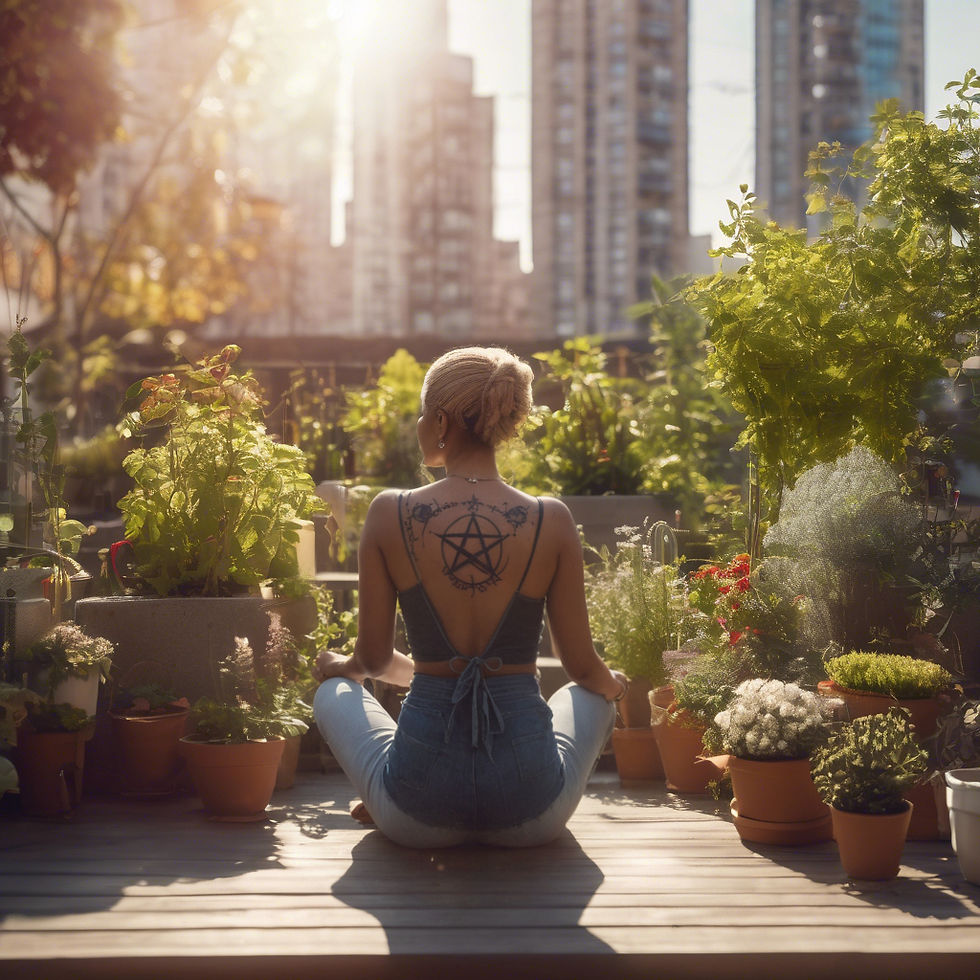
Not as an escape from the world, not as retreat to the remote—but as deep immersion. Choosing not to look for spirituality “out there,” but right here: between street noise and calendar pressure, between subway station and inbox. Urban Mysticism means the divine doesn’t start when everything is quiet. It starts precisely when it isn’t. It means you don’t need a temple if your life can become one. No guru, if you learn to listen. No secret circle, if you are present.
Urban Mysticism isn’t grand theater. It’s not the perfect ritual setup, not aesthetic spirituality for social media. It’s a practice of presence. A breath before your next meeting. A moment of spaciousness while the city pulses outside. An inner coming home, in the middle of chaos.
For me, Urban Mysticism is…
…drinking matcha while Zurich rushes by and suddenly feeling: I am part of something.
…when corporate life meets spellwork—not as a contradiction, but as reality.
…when I don’t have to choose between psychology and mysticism, between nervous system and night magic.
Because Urban Mysticism is also this: being grounded. Regulated. Embodied. Not floating away, but arriving. Living with open eyes. A heart that doesn’t go cynical. And the quiet, rebellious choice that even an ordinary life can be permeable to the sacred..
Urban Mysticism is spirituality without gatekeeping
Maybe the most urban truth of all: Mysticism needs no dogma. No exclusivity. No “first you must…” It doesn’t say: This is the truth. It says: Come closer. Feel for yourself. Spirituality as an open stance, not exclusive knowledge. And perhaps the most rebellious form of magic is this: not believing because you have to—but experiencing because you live.
And how does this connect to earth-based spiritual practice, witchcraft, and animism?
Here it gets personal, because: mysticism is the experience, witchcraft and earth-based spirituality the practice I choose to give my experiences expression. In my animistic worldview, where everything is alive, the divine can potentially be found everywhere—in every stone, every plant, every breath of the city. My omnistic view means truth isn’t exclusive, but shows itself in many forms—sometimes in fragments, sometimes in full force.
Witchcraft for me is the way to live this experience: rituals, working with symbols, observing natural cycles, small magical acts in everyday life. They are not duties or dogma, but bridges between inner wonder and lived life, between longing for depth and the here and now.
3 small Urban-Mystic moments for everyday life
Urban Mysticism doesn’t need to be complicated. It happens in small ways, between tram stops and meetings, emails and dinner. Three simple ways to feel it yourself:
The breath of the city
Pause for a moment, wherever you are. Breathe consciously, listen to the rhythm around you: the clatter of trams, footsteps on asphalt, the murmur of people. Feel that all of it is part of a greater whole, alive through you.
Little rituals in daily life
Sigils in a notebook, a tiny bundle of herbs on the windowsill, a consciously poured matcha or tea—small, sensual acts that connect you to the sacred in the ordinary. It’s not about perfection, not even about what you specifically choose to do, but about presence.
Wonder in the everyday
A sunbeam through the window, the smell of rain on asphalt, the night sky above city rooftops. Let these moments affect you without needing to categorize them. Wonder is already mysticism.
Bridge to further topics
Urban Mysticism is just the beginning. Once you notice how much the divine pulses in every moment, whole worlds of possibility open: nature’s cycles, the magic of inner work, symbol work, narrative magic, ritual practices, mindfulness in daily life. All of this can weave into a life that doesn’t have to choose between spirituality and reality—but lives both at once.
In future posts, we can explore: How to intentionally integrate Urban Mysticism into your daily rhythm, how rituals can become small anchors for your nervous system, or how narrative magic and symbol work make the experience of depth tangible in everyday life.


.png)


Comments